Understanding Germany in Times of Genocide: Franz Neumann and the Ongoing Question of Imperialism
MPIfG Lecture
- Date: Jul 8, 2026
- Time: 04:30 PM - 06:00 PM (Local Time Germany)
- Speaker: Kai Koddenbrock
- Bielefeld University
- Sign up: info@mpifg.de
- Location: Cologne
With its national-socialist past and the steadfast support to the current Israeli government, Germany constitutes an important object of academic analysis and political intervention. The relationship of German governments and the German people to extreme violence is again an enormous analytical task for the social sciences. There are analytical resources to tackle it. During the rise of national socialism and after organizing the Holocaust, Germany became a heart of theorizing the relationship between imperialism, fascism, racism, and antisemitism, for example in the work of Franz Neumann and other Frankfurt School intellectuals. Yet hidden under the US security umbrella for the last 80 years and supported by the quick resumption of relations with Ben-Gurion’s Israel, theorizing German political economy and ways of relating to the world have tended to be dominated by liberal and institutionalist analysis unaware of this long and powerful tradition of critique. Complacency has set in. The contemporary institutions of German Peace Research and International Relations are far from nurturing that tradition of anti-fascist and anti-imperialist theorizing in the spirit of preventing mass violence. In the face of exploding investments into the weapons industry, the rise of the AfD, and the silence in the face of plausible genocide, Kai Koddenbrock’s talk explores how these old and more recent theories of fascism and of imperialism can help us make sense of the current German “model.” This “model” is a combination of a domestic growth and accumulation regime, of managing its citizens and labor force, and of relating to the world with its corporations and foreign policy. Ultimately, the question is whether and how Germany may manage to organize itself in a way that is less violent both domestically and globally.
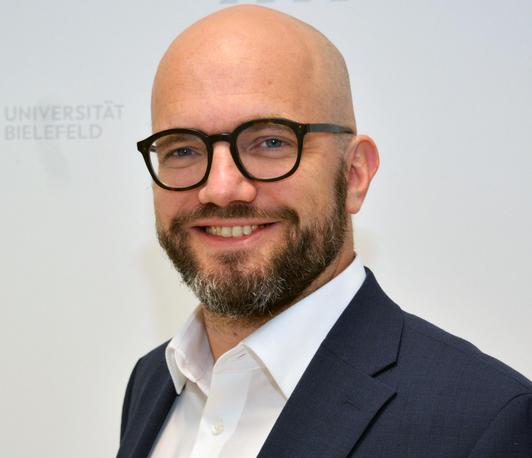
Kai Koddenbrock is Professor of International Relations and Political Economy at Bielefeld University. His work operates at the interface of political economy, international relations, and postcolonial theory and examines questions of political and economic sovereignty, financialization, and global power relations, particularly in the Global South. He has recently turned his attention to questions of geoeconomics, rearmament in Germany, and the European race for critical raw materials. He has spent research stays at Columbia University, Sciences Po, the Institute for Advanced Studies, Paris, and the Max Planck Institute for the Study of Societies, among others. He is associated with the Global South Studies Centre at the University of Cologne. Among his publications are Delinking and Global Reparations (transcript 2025, with Ndongo Samba Sylla), Capital Claims: Power and Global Finance (Routledge 2023, with Benjamin Braun), Economic and Monetary Sovereignty in 21st Century Africa (Pluto Press 2021, edited with Maha ben Gadha, Fadhel Kaboub, Ines Mahmoud, and Ndongo Samba Sylla), and The Practice of Humanitarian Intervention (Routledge 2015).
Suggested preparatory reading:
Patrick Eiden-Offe. 2026. „Was ist Faschisierung? Einige theorie- und begriffshistorische Überlegungen.“ Merkur 922.
Kai Koddenbrock. 2025. „Walking a Fine Line: Germany and the Question of Imperialism.“ New Political Economy, published online November 11, 2025.