Summer Conference on Economy and Society
Anniversary Conference
- Start: Jun 21, 2026
- End: Jun 24, 2026
- Location: Central European University, Vienna
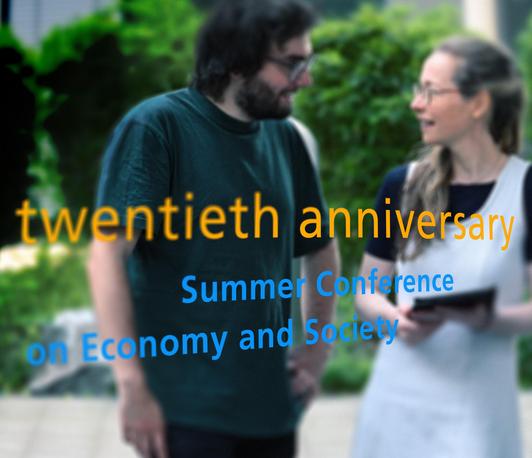
An unusual academic conference has been held every summer for the last twenty years: the Summer Conference on Economy and Society. What began as a small workshop now brings together doctoral students and established researchers from Europe and the United States year after year. The focus is on the exchange of ideas about research at the intersection of economics, politics, and society. This has given rise to a network that shapes career paths and institutional collaborations in the long term.
A small group of researchers in sociology and political economy met at Villa Vigoni on Lake Como in the summer of 2006. This was nothing more than an exploratory workshop, yet that meeting gave rise to a tradition. The approach is unusual: The focus is not on the results of completed research projects or prominent speakers, but on doctoral students—and on discussion. This meeting gave rise to the Summer Conference on Economy and Society, which for twenty years has served as a regular meeting place for early-career researchers as well as professors from leading universities on both sides of the Atlantic. The format is simple: Over the course of four days, keynote presentations by established researchers alternate with intensive workshop sessions in which doctoral students present their dissertation projects. The underlying principle is that advances in research come from continuous academic exchange across institutional, disciplinary, and academic-cultural boundaries. Since its inception, the conference network has included the MPIfG, Sciences Po, and Northwestern University; Brown University, the University of California, Berkeley, and the Central European University joined later. Harvard University, Columbia University, and the European University Institute have also been part of the network at times. The conference is held alternately at the participating institutions. Its continuity is remarkable: What began as a one-off initiative has, over the years, become a lasting intellectual bridge across the Atlantic—a forum that connects research traditions and generations of scholars.
Dialogue between research disciplines
Economic sociology and political economy both concern themselves with capitalism, but they have developed differently within distinct disciplinary and national contexts. European sociology emphasizes institutions, social relations, and the social embeddedness of markets; American political economy is often more concerned with formal models, comparative institutional analysis, and public policy issues. The goal was to establish a lasting dialogue in this area. This motivation became more urgent as the underlying conditions changed. The 2008 financial crisis, growing social inequalities, and the political consequences of economic transformations demonstrated that economic processes cannot be understood without their social and political contexts. Questions about markets also require attention to institutions, cultural practices, and political conflicts. This conference is dedicated precisely to this kind of integrative discussion. The range of topics was deliberately kept broad. The presentations addressed labor markets, welfare states, corporate organization, financial systems, technological change, migration, and processes of ecological transformation. No single paradigm, no narrow canon: The value of the conference lies in familiarizing participants with different theoretical approaches and empirical strategies and encouraging them to situate their research within a broader academic context.
A conference for early-career researchers
The focus of the Summer Conference is on researchers at the very start of their careers. Each partner institution sends a small group of doctoral students, accompanied by faculty members who serve as discussants and moderate the sessions. The presentations feature work in progress, not completed projects. This fundamentally changes the atmosphere. Without the pressure of having to defend research results, the discussions are exploratory rather than competitive. Experienced researchers provide detailed feedback, methodological guidance, and constructive criticism. Equally valuable is the contact between the doctoral students themselves: They encounter research questions and approaches that may not play such a significant role at their home institutions. The Summer Conference is for many their first opportunity to present their research to an international audience. Thus it also serves as a place to learn how to formulate arguments, handle criticism, and situate one’s own work within broader debates.
A close-knit network has developed over the years: faculty members return regularly; former doctoral students who have pursued an academic career sometimes take part again. These encounters have given rise to collaborative projects and institutional partnerships, including doctoral programs between individual partner institutions. In an era of large, fast-paced conferences and congresses, the Summer Conference deliberately follows a different model. With a small number of participants, extended sessions, and a focus on discussion, informal conversations over meals or during walks are considered an integral part of the event, rather than just optional activities. Two decades of experience demonstrate just how irreplaceable these personal interactions are.
The value of continuity
Since its inception, the conference has been held annually. The only interruption was during the pandemic when one meeting was held online. It is precisely this consistency that has become one of its greatest strengths. Core themes such as capitalism, inequality, and social change recur regularly—each time in new empirical or theoretical contexts—and thus shape the development of academic research in a quiet yet lasting way. The value of the Summer Conference thus also lies in the generation and dissemination of knowledge. It supports early-career researchers during a formative phase, as they test ideas, refine research designs, and build professional networks. At the same time, it keeps the dialogue between different academic traditions alive. In an academic system increasingly shaped by specialization and competition, such open forums for discussion are not a given. By bringing together doctoral students and experienced researchers and bridging European and American traditions, the conference strengthens the ability of the social sciences to understand economic and social transformations.
The Summer Conference was never intended to be a spectacular event. Its significance lies in its continuity and the depth of the exchange it facilitates. What began as a one-off gathering has evolved into a community—and what started as an idea has become a practice that demonstrates how scholarship works at its best. The Summer Conference will celebrate its twentieth anniversary in 2026. When it was founded, the goal was to foster an ongoing dialogue between economic sociology and political economy. The 2023 conference was held at Northwestern University in Chicago.